Aspiration to Elevate the Customer Experience Through Technology
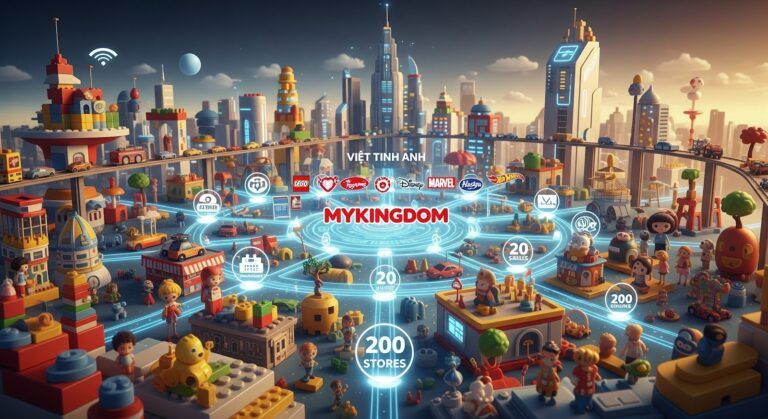
Viet Tinh Anh (MyKingdom) is the largest children’s toy distributor in Vietnam, operating a large-scale, multi-brand retail ecosystem. Founded with the vision of becoming the country’s leading “toy kingdom,” the company has built an extensive nationwide network of more than 200 physical stores
Viet Tinh Anh (MyKingdom) is the largest children’s toy distributor in Vietnam, operating a large-scale, multi-brand retail ecosystem. Founded with the vision of becoming the country’s leading “toy kingdom,” the company has built an extensive nationwide network of more than 200 physical stores
As a long-term strategic partner of global brands including LEGO (Denmark), Mattel (USA), Spin Master (Canada), and Siku (Germany), MyKingdom not only delivers high-quality products but also brings educational and creative values to millions of Vietnamese children.
The Search for an Omni-Channel Solution
Recognizing the importance of seamless customer experiences across all touchpoints, MyKingdom adopted an Omni-Channel strategy early on, aiming to tightly connect online and offline shopping journeys.
With nearly two decades of experience working alongside international toy brands, this strategy became a natural and necessary step to meet rising customer expectations while optimizing retail operations.
Omni-Channel as the Core of Digital Transformation
Omni-Channel is not merely about being present on multiple sales channels. It is the unification of every customer touchpoint – physical stores, websites, mobile applications, social media, and e-commerce marketplaces – into a single, cohesive ecosystem.
The goal is to provide customers with a consistent and seamless experience, regardless of how or where they choose to shop.
To realize this vision, MyKingdom began building its Omni-Channel operating platform several years ago using two popular open-source technologies:
- Magento – A powerful and flexible eCommerce platform known for deep customization and a rich extension ecosystem.
- Odoo – A comprehensive open-source ERP system used to manage orders, inventory, and act as middleware to synchronize data across sales channels.
Limitations of an Open-Source Architecture
While this architecture enabled MyKingdom to quickly launch its Omni-Channel platform and synchronize online and offline data, growing operational scale and data volume exposed critical limitations. Magento and Odoo – once suitable for the early stage – no longer aligned with the company’s evolving operational policies and long-term growth strategy.
Magento – Powerful but Costly
Magento is highly regarded for performance and scalability, but it comes with significant operational overhead. The platform requires a specialized technical team to manage infrastructure, security, performance optimization, and frequent updates.
In addition, premium extensions and themes are costly, while customization and testing cycles are often lengthy. Over time, the total cost of ownership (TCO) – including hosting, maintenance, and engineering resources – became a major concern for MyKingdom.
Odoo – Comprehensive but No Longer Aligned
Odoo initially supported MyKingdom effectively as a centralized ERP solution. However, as integration requirements expanded, the platform demanded increasingly specialized expertise for customization and maintenance – driving up personnel costs and development timelines.
As a result, Odoo no longer fit MyKingdom’s vision of a lean, flexible, and scalable operating model in its current phase of digital transformation.
Managing Change with Microsoft Dynamics AX 2012
Another layer of complexity within MyKingdom’s technology ecosystem was Microsoft Dynamics AX 2012, the core ERP system managing enterprise-wide operations.
All operational changes – from pricing updates and inventory management to order processing – had to be configured and approved through AX. Each change followed a multi-step process involving proposal submission, feasibility assessment, cost estimation, and implementation by ERP partners, often taking weeks or even months.
This reality highlighted the need for an integration approach that minimized dependency on ERP changes while preserving data integrity and operational speed.
Talent Challenges and Technical Debt in Open Source
Beyond technical constraints, MyKingdom faced significant human resource challenges in operating open-source platforms like Magento and Odoo.
As a retail company rather than a technology firm, building and retaining a highly skilled internal engineering team proved difficult. Open-source systems require developers with deep architectural understanding, yet recruiting and retaining senior-level talent for largely internal systems offered limited long-term career growth.
The flexibility of open-source technology also became a double-edged sword. While junior developers could quickly contribute, inconsistent implementation often resulted in technical debt that even senior engineers struggled to control.
One of the most common issues was the Point-to-Point integration trap, which significantly impacted system stability and scalability.
The Point-to-Point Integration Trap
With multiple systems connected directly to one another, MyKingdom’s architecture evolved into a complex web of point-to-point integrations between ERP, Magento websites, and marketplace platforms such as Shopee, Lazada, TikTok Shop, and Tiki.
Key limitations included:
- Exponential complexity: Each system has its own data models, APIs, and business logic. Integrating additional systems multiplied overall complexity rather than adding linearly.
- Difficult maintenance: Each connection was built using different technologies, increasing development costs and making troubleshooting highly complex.
- Lack of reusability and standardization: Custom-built integrations were difficult to reuse, leading to fragmented and inconsistent implementations.
- Tight coupling: Changes in one system often caused cascading failures across others, limiting flexibility and making system upgrades risky.
After years of operating under these constraints, MyKingdom sought a more stable and future-ready solution – and found the answer in SaaS-based platforms.
From Open Source to SaaS: A Strategic Shift
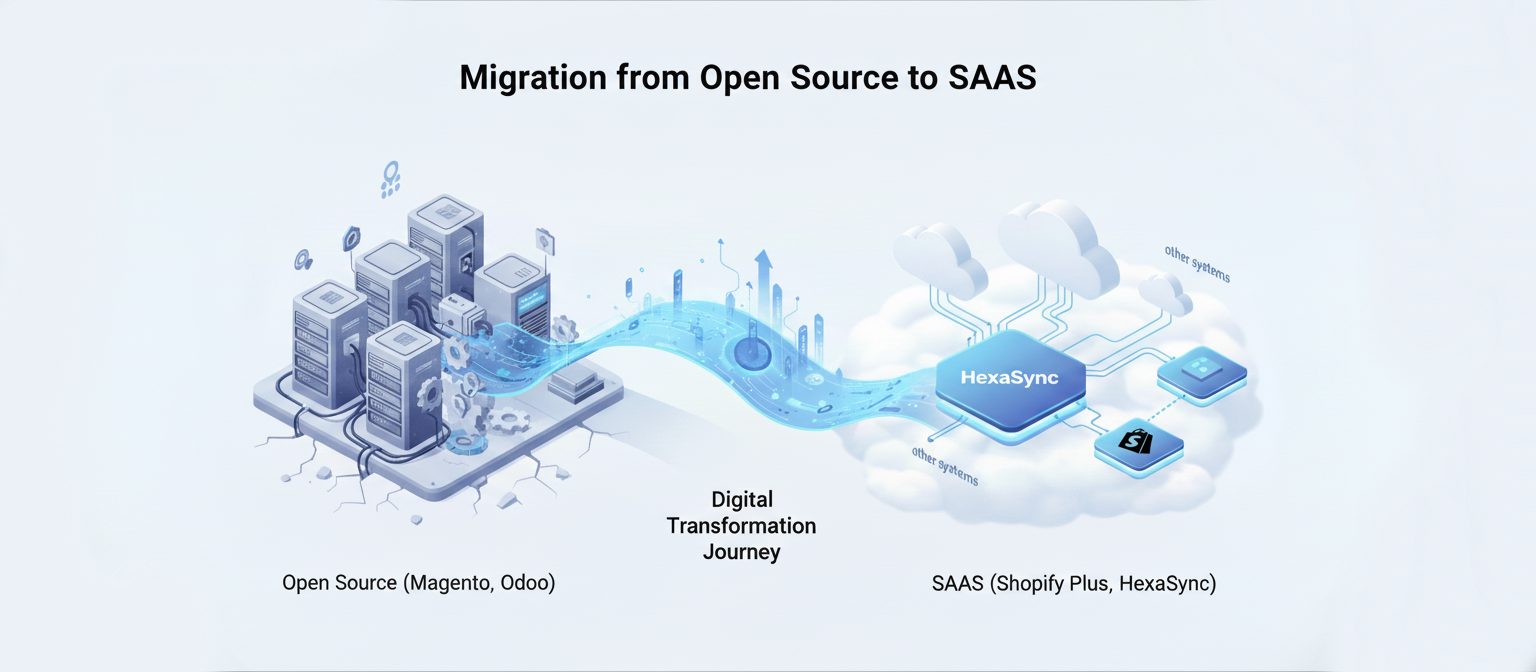
Recognizing that open-source solutions could no longer support its growth trajectory, MyKingdom initiated a comprehensive transformation – not merely replacing individual systems, but redefining its technology philosophy toward Software as a Service (SaaS).
- Migrating eCommerce from Magento to Shopify Plus, favoring a more user-friendly, scalable, and cost-efficient platform.
- Replacing Odoo middleware with a modern integration solution aligned with Omni-Channel objectives.
Replacing Magento with Shopify Plus
To streamline its eCommerce infrastructure, MyKingdom transitioned from Magento to Shopify Plus.
Shopify Plus offered flexible scalability, robust infrastructure, and simplified governance – allowing MyKingdom to reduce technical overhead, accelerate feature deployment, and respond more quickly to market demands.
Replacing Odoo Middleware with HexaSync iSaaS
MyKingdom required more than a technology provider – it needed an integration architect capable of redesigning its entire system landscape. This included understanding complex business workflows, navigating legacy ERP API constraints, and reshaping integrations between ERP, eCommerce platforms, and marketplaces.
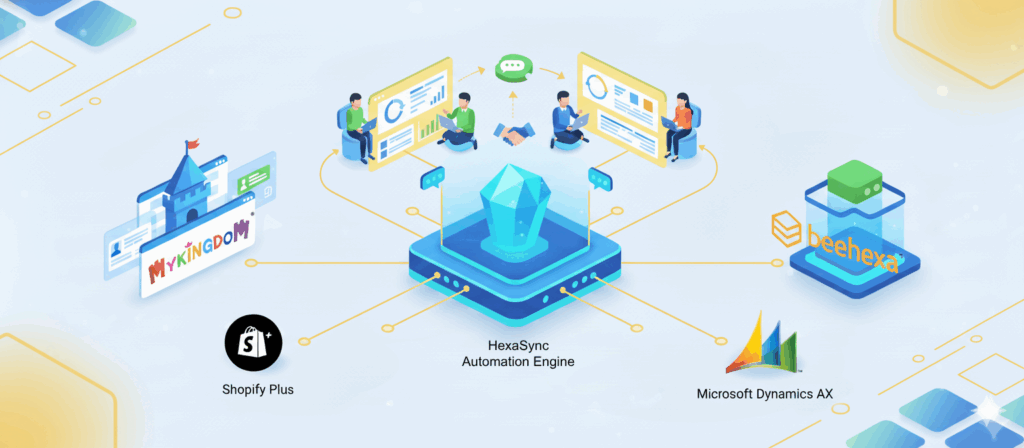
After extensive evaluation, MyKingdom selected HexaSync Automation Engine, developed by Beehexa, as its integration backbone.
Moving Away from Point-to-Point with SaaS Middleware
As an iSaaS (Integration Software as a Service) platform, HexaSync fundamentally transformed how Microsoft Dynamics AX 2012 connected with MyKingdom’s digital ecosystem.
Under the new architecture:
- Microsoft Dynamics AX 2012 is the single source of truth for Shopify Plus.
- Shopify Plus becomes the centralized hub for all marketplace channels.
- HexaSync acts as the middleware backbone, standardizing data flows and dramatically reducing integration complexity.
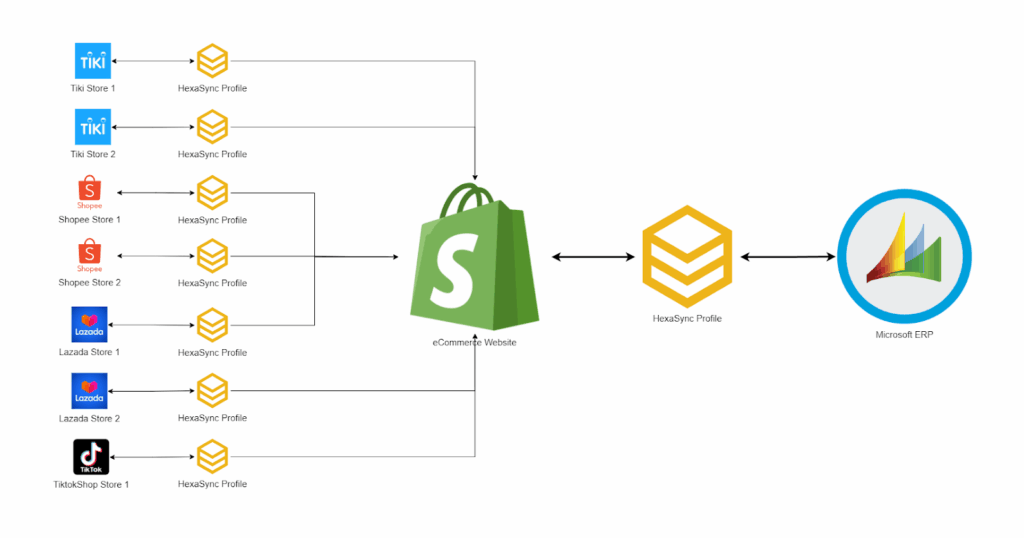
HexaSync now serves as the operational spine of MyKingdom’s Omni-Channel ecosystem.
To support these integrations, MyKingdom deployed 14 HexaSync profiles, each dedicated to a specific synchronization flow.
- ERP ↔ Shopify MyKingdom
- Shopify MyKingdom functions as the primary hub, receiving standardized data from ERP and distributing it consistently to all downstream channels.
- Shopify MyKingdom ↔ Satellite Stores
- Shopify MyKingdom also serves as the data source for other brand websites such as Clever Collection, Outlet, Hobiverse, and internal sales platforms. HexaSync adapts data flows based on the specific requirements of each sub-brand.
- Shopify MyKingdom also serves as the data source for other brand websites such as Clever Collection, Outlet, Hobiverse, and internal sales platforms. HexaSync adapts data flows based on the specific requirements of each sub-brand.
- Shopify MyKingdom ↔ Marketplaces
- In addition to internal websites, Shopify MyKingdom integrates seamlessly with major marketplaces including Shopee, TikTok Shop, Lazada, and Tiki.
Results Achieved
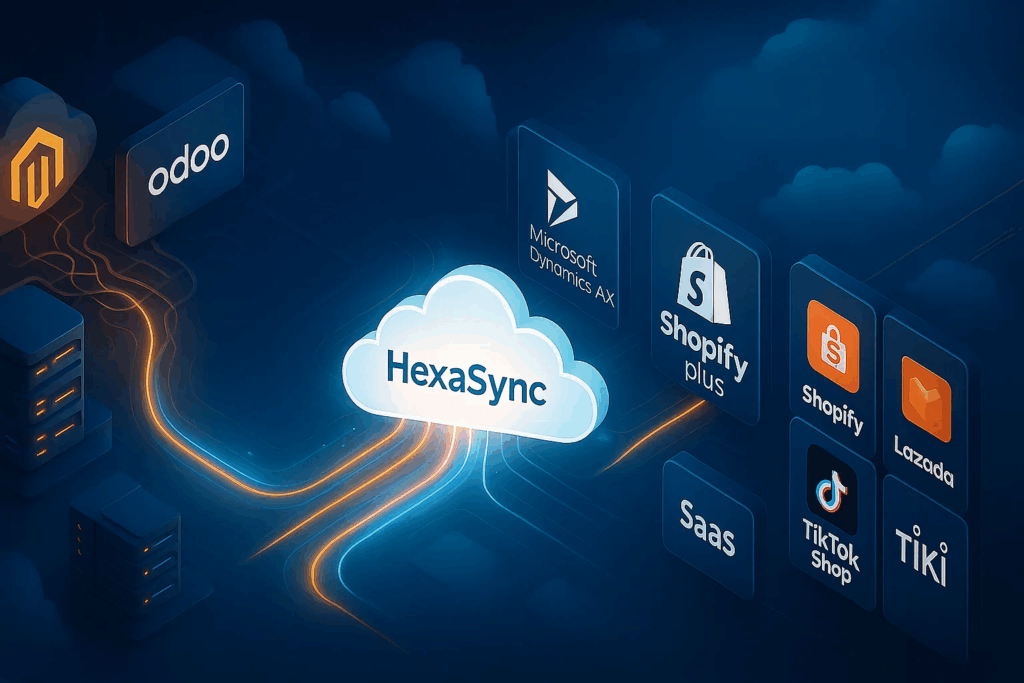
Real-Time Data Synchronization at Scale
The new integration architecture enabled MyKingdom to:
- Automatically synchronize nearly 5 million inventory changes per day across ~200 stores and more than 10 online channels.
- Maintain real-time synchronization without creating ERP bottlenecks.
- Reduce internal technical support workload for eCommerce channels by 50%.
- Support complex inventory rules for specific product categories.
- Offload ERP workload through HexaSync task orchestration, reducing downtime and improving synchronization speed.
While synchronization speed is important, stability and data quality remain HexaSync’s top priorities. Synchronization schedules and data throughput are carefully configured based on system capacity and business priorities, ensuring stable go-live operations.
Cost Optimization and Operational Efficiency
- Lower total cost of ownership (TCO)
- Faster incident resolution
- More efficient use of internal operational resources
Key Success Factors
Unlimited Scalability with HexaSync
- As a middleware platform, HexaSync provides exceptional scalability and flexibility, enabling MyKingdom to integrate large data volumes and easily expand to new platforms.
- HexaSync is also designed to support unknown future requirements, empowering MyKingdom to design new automation scenarios as business needs evolve.
Strong Project Governance and Collaboration
The project’s success was driven by close collaboration between MyKingdom, Beehexa, and MeowCart.
MeowCart, with extensive experience in Shopify Plus implementation, consistently trusted and partnered with Beehexa throughout the integration design process.
Agile & Scrum Execution
Beehexa’s long-standing experience with Agile and Scrum methodologies allowed the project to evolve iteratively – prioritizing high-value features while refining requirements throughout execution.
MyKingdom’s Commitment to Transformation
After more than eight months of implementation, MyKingdom successfully completed the first phase of its integration initiative, connecting over 10 sales channels across ERP, Shopify Plus, and major marketplaces.
A MyKingdom project representative shared:
“The Beehexa team consistently demonstrated professionalism, dedication, and flexibility. They never said no to our requirements and always proactively found solutions to ensure system stability throughout the transition.”
This strong partnership laid a solid foundation for future phases in MyKingdom’s digital transformation journey.
Conclusion
MyKingdom stands as a compelling example of how shifting from open-source architectures to SaaS-based platforms can unlock scalability, stability, and operational efficiency in solving the Omni-Channel challenge.
By leveraging Shopify Plus and HexaSync Automation Engine, MyKingdom has built a future-ready digital backbone to support sustainable growth.
What is your integration challenge?
Contact Beehexa at hello@beehexa.com to explore how HexaSync can support your digital transformation today.