The “Vibe Coding” trend – using AI tools like Copilot, Cur – sor, or ChatGPT to generate entire application logic – is fundamentally changing how we build software. You describe an idea, and the AI spits out thousands of lines of code that run smoothly on the very first try. The experience feels like magic.
But there is a harsh reality: AI models are trained on millions of open-source repositories and tutorials that date back 5 to 10 years. Many of the architectural patterns they suggest have been deprecated in modern security standards. Your source code might flawlessly execute the business logic, but it could also be leaving the front door wide open for hackers.
If you are developing an authentication system (SSO), managing user identities, or processing sensitive data, this article is for you. Based on the rigorous OWASP ASVS 5.0 Level 2 security verification standard from a real-world enterprise audit, here are 10 dangerous “keyword” groups. Open your codebase right now, hit Ctrl + Shift + F, and search for them. If they appear, your project is likely sitting on a ticking time bomb.
PART 1: FATAL FLAWS IN AUTHENTICATION & SESSION MANAGEMENT
Authentication is usually the first feature AI suggests for you, and ironically, it is where the most “legacy garbage code” resides from a security standpoint.
1. Keywords: HS256, SymmetricSecurityKey, SharedSecret
- The Warning Sign: When you ask an AI to write a JWT (JSON Web Token) login feature, 90% of the time it will utilize a symmetric HMAC algorithm (like HS256) combined with a shared secret string (e.g., your-256-bit-secret).
- Why it’s dangerous (Deep-dive): Using Symmetric Cryptography for tokens means that anyone who gets their hands on this secret string has ultimate power. This string is often leaked because it gets hardcoded into configuration files, accidentally written into logs, or taken by former employees. Once compromised, a hacker can forge valid tokens to impersonate any Admin user without your system ever noticing. Worse yet, with HS256, you have no mechanism to revoke a compromised key in isolation without logging everyone out.
- OWASP ASVS Remediation:
- For API-to-API communication: You must transition to a Split-key (Asymmetric Cryptography) architecture using algorithms like RS256 or ES256 (ECDSA). The authorization server holds the Private Key to sign the tokens, while Resource Servers only need the Public Key (usually retrieved via a JWKS endpoint) to verify the signature.
- For User Sessions: Completely eradicate the practice of sending JWTs to the browser. According to modern standards, you should use Opaque Tokens. An Opaque Token is merely a cryptographically secure random string stored in a Redis cache. When the user sends this token, the server looks it up in Redis to retrieve the session data. This completely mitigates the risk of signing-key exposure and allows you to enforce immediate, absolute session revocation (forced logout).
2. Keywords: Set-Cookie (without the __Host- prefix)
- The Warning Sign: The AI helps you store your session token in a Cookie equipped with the HttpOnly, Secure, and SameSite=Lax/Strict flags. You might think this is perfectly safe. It is not.
- Why it’s dangerous (Deep-dive): Web browsers have a legacy design flaw: Cookies do not enforce strict isolation between subdomains. If your main application lives at app.yourdomain.com, but your company has an outdated, vulnerable blog at blog.yourdomain.com, a hacker can compromise the blog and execute a “Session Fixation” attack. They can force the browser to overwrite the session cookie on app.yourdomain.com from the vulnerable subdomain.
- OWASP ASVS Remediation:
- All sensitive cookies acting as identifiers (session tokens, refresh tokens) absolutely must be prefixed with __Host- (for example, __Host-session_token).
- When a browser detects this exact prefix, it activates extreme protection mode: The cookie must have the Secure flag, the Path must be set to /, and the Domain attribute must be strictly omitted. This locks the cookie exclusively to the exact hostname that issued it, entirely preventing any cross-subdomain tampering or reading.
3. Keywords: session.Clear(), localStorage.removeItem()
- The Warning Sign: When implementing a Logout feature, AI typically invokes a command to clear the session on the server backend or wipes the cache via the UI (JavaScript).
- Why it’s dangerous (Deep-dive): You can never fully control what the user’s browser is storing locally. Hidden background tabs, web workers, IndexedDB instances, or garbage collection buffers might still retain sensitive data. If a user logs out on a public computer, the next person sitting down could use memory recovery tools or simply hit the “Back” button to resurrect the data.
- OWASP ASVS Remediation:
- Alongside destroying the session in the backend database or Redis, your backend’s Logout endpoint must explicitly return the following HTTP Header: Clear-Site-Data: “cookies”,”storage”.
- This header is the official “kill switch” mandated by W3C. Upon receiving it, the browser engine itself aggressively wipes all residual data from LocalStorage, SessionStorage, IndexedDB, and all Cookies tied to the website at the operating system level, ensuring absolute safety after a logout event.
PART 2: APPLIED CRYPTOGRAPHY PITFALLS
AI models do not inherently understand Applied Cryptography. They default to the easiest-to-write algorithms to complete the task, creating a goldmine for attackers looking to cause a Data Breach.
4. Keywords: AES-CBC, IV = new byte, or Zero-IV
- The Warning Sign: When you ask to encrypt sensitive data before storing it in a database (Data-at-rest), AI often suggests AES in CBC mode. Worse, to make the code run seamlessly without managing extra parameters, AI frequently initializes the Initialization Vector (IV) with an array of all zeros (Zero-IV).
- Why it’s dangerous (Deep-dive):
- Deterministic Ciphertext: Using a Zero-IV means that if you encrypt the word “Hello” ten times, you will get ten identical encrypted strings. Hackers can simply analyze the frequency of encrypted strings in your database to guess the original data (this is highly critical for fields like Gender, Country, or Status).
- Lack of Authenticity: AES-CBC only encrypts data; it does not check for Data Integrity. A hacker could execute a Bit-flipping attack by blindly modifying bytes in your database, altering the decrypted output without your system ever throwing an error.
- OWASP ASVS Remediation:
- Completely deprecate AES-CBC. Transition to Authenticated Encryption with Associated Data (AEAD) algorithms, specifically AES-256-GCM. The GCM standard simultaneously encrypts the data and generates an Authentication Tag, ensuring the payload cannot be silently tampered with.
- Envelope Encryption Architecture: Never hardcode a Master Key into your application source code. Modern roadmaps dictate using a two-tier key system: A Data Encryption Key (DEK) encrypts the actual database rows, while a Key Encryption Key (KEK) – safely vaulted inside infrastructure like Azure Key Vault or AWS KMS – encrypts the DEK. This architecture allows you to perform periodic Key Rotations (e.g., every 180 days) without having to decrypt and re-encrypt your entire database.
5. Keywords: new Random(), Math.random()
- The Warning Sign: Using standard Random functions to generate password recovery codes, Email OTPs, or system secrets.
- Why it’s dangerous (Deep-dive): Standard random functions are mere Pseudo-Random Number Generators (PRNG). They generate numbers based on a “seed,” which is typically the system clock. If a hacker knows the exact millisecond your server generated an OTP, they can reverse-engineer the algorithm and predict exactly what the OTP string is.
- OWASP ASVS Remediation: All authentication tokens, OTPs, or secret recovery codes must be generated using a CSPRNG (Cryptographically Secure Pseudo-Random Number Generator). Furthermore, these codes must have an extremely short lifespan (e.g., Email OTPs live for 10 minutes, TOTP lives for 30 seconds) and must be rigorously invalidated immediately after exactly one use (Atomic Single-use).
6. Keywords: MD5, SHA1, SHA256, PBKDF2 (For Passwords)
- The Warning Sign: Your system is hashing user passwords using MD5, SHA, or even PBKDF2.
- Why it’s dangerous (Deep-dive): Modern hardware is overwhelmingly powerful. Specialized Graphics Processing Units (GPUs) can brute-force billions of MD5 or SHA256 hashes per second. These algorithms were intentionally designed to compute data “as fast as possible,” which becomes a fatal flaw when applied to passwords.
- OWASP ASVS Remediation: You must use “Memory-hard” hashing algorithms that require significant RAM to compute, effectively neutralizing the parallel processing power of GPUs. The current industry standard (endorsed by ASVS) is Argon2id. These algorithms allow you to configure a “work factor” ensuring that each hash takes at least a few hundred milliseconds, making offline brute-force attacks against a leaked database financially and computationally unfeasible.
PART 3: OAUTH 2.0 AND SSO INTEGRATION TRAPS
If you are building a “Login with Google/Facebook/Microsoft” feature, AI will frequently hand you highly vulnerable authorization flows.
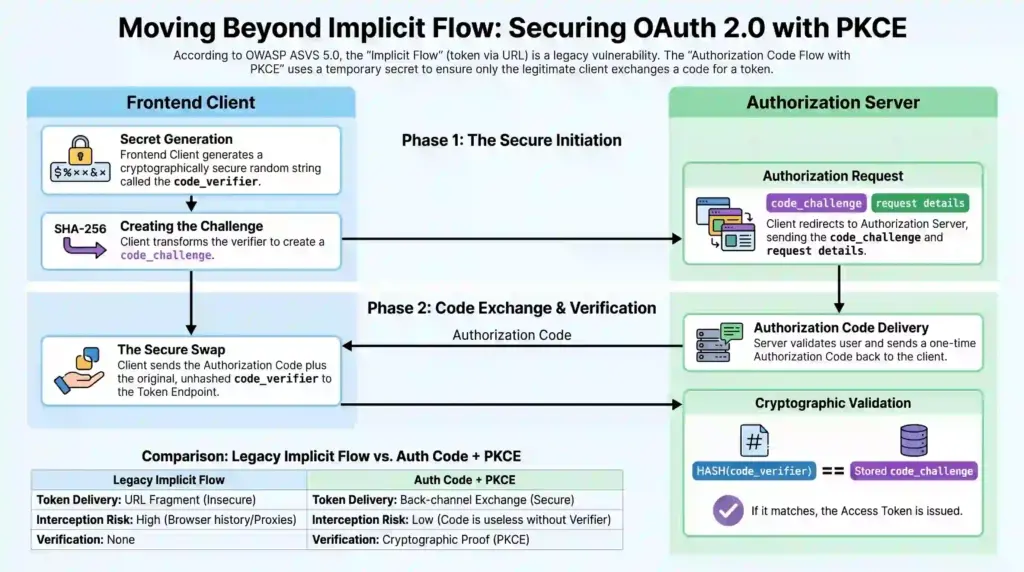
7. Keywords: response_type=token, Implicit Flow
- The Warning Sign: Your Frontend Single Page Application (SPA) calls the SSO system and requests the Access Token to be returned directly in the URL bar (Implicit Flow).
- Why it’s dangerous (Deep-dive): The Implicit Flow is a relic from a decade ago. Returning a token in the URL guarantees that it will be saved in the browser’s history, recorded by corporate network proxies, and easily stolen by malicious browser extensions.
- OWASP ASVS Remediation: Completely eliminate the Implicit Flow. You must strictly enforce the Authorization Code Flow combined with PKCE (Proof Key for Code Exchange). By utilizing a code_challenge and a code_verifier, only the exact client that initiated the original request (who holds the verifier) can exchange the code for a Token. Even if an attacker intercepts the Authorization Code over the network, it is useless to them.
8. Keywords: Reusing Authorization Code
- The Warning Sign: Your system receives a code, validates it, generates a token, and returns it. However, you lack a concurrency mechanism to prevent that exact same code from being redeemed a second time.
- Why it’s dangerous (Deep-dive): An Authorization Code is a single-use ticket. If a hacker steals this ticket and executes a Race Condition attack – calling the server milliseconds before your legitimate client does – they will hijack the token.
- OWASP ASVS Remediation:
- The mechanism swapping a Code for a Token must guarantee “Atomic Single-use”. In enterprise architectures, this is achieved using a locking mechanism or an atomic KeyDelete command in Redis: Only the thread that successfully deletes the key is granted the token.
- Moreover, if the authorization server detects an attempt to redeem a code for the second time, it must treat this as an active theft. It must immediately revoke all Access Tokens and Refresh Tokens previously issued from that specific code.
9. Keywords: Mapping users by Email (email_verified=false)
- The Warning Sign: When integrating “Login with Microsoft/Facebook”, your system reads the email claim from the returned payload and automatically logs the user in (or creates an account) if the email matches a record in your database.
- Why it’s dangerous (Deep-dive – The nOAuth Vulnerability): Many Identity Providers (IdPs) allow users to input arbitrary emails when creating their accounts without verifying ownership (Unverified Email). If your system blindly trusts this email claim, a hacker could create a fake Microsoft account using the email admin@yourcompany.com, and click “Login with Microsoft” to bypass authentication and breach your admin panel.
- OWASP ASVS Remediation: Never use Email as the Primary Key to map identities from External IdPs. You must rely on the immutable duo: idp (Identity Provider Name) + sub (Subject ID – the unique, unchangeable ID of the user on that platform). Email should strictly be used for display or notification purposes. If you wish to use an Email to “link” accounts, your system must generate an out-of-band OTP verification flow to prove the user actually owns that inbox before merging the accounts.
PART 4: API DEFENSE & ARCHITECTURE
10. Keywords: X-Forwarded-For as the basis for Rate Limiting
- The Warning Sign: You write a Rate-limiting mechanism to stop password Brute-force attacks. To identify the user’s IP, AI advises you to read the X-Forwarded-For (XFF) HTTP Header.
- Why it’s dangerous (Deep-dive): X-Forwarded-For is a header that the Client can freely manipulate (IP Spoofing). A hacker writing a Brute-force script can dynamically inject fake IPs into this header on every single request (e.g., 1.2.3.4, then 1.2.3.5). Your rate-limiting middleware will be fooled into thinking every request is coming from a unique user, completely bypassing your defenses and leaving your database exposed to credential stuffing.
- OWASP ASVS Remediation: Never trust the raw XFF header directly. IP resolution must occur at the Edge Layer or via standardized Middleware that checks trusted proxies. Only extract the original IP from an authenticated, trusted intermediary proxy configuration (like Cloudflare or AWS ALB networks) using the X-Real-IP or PROXYv2 protocols. All security decisions, especially blocking Brute-force attacks on 2FA endpoints, must strictly rely on this mathematically verified, unspoofable Resolved IP.
11. Keywords: UpdateUser(UserViewModel request) (Mass Assignment)
- The Warning Sign: AI generates a PUT /users/me API to update personal profiles. It takes a Data Transfer Object (DTO) directly from the user’s payload and maps it straight to the Database Entity using an auto-mapper tool.
- Why it’s dangerous (Deep-dive): This introduces a classic Mass Assignment vulnerability. Even if your UI only renders two input fields (Name and Age), a hacker using Postman can inject sensitive fields into the JSON payload, such as “Role”: “Admin” or “IsVerified”: true. If the system blindly auto-maps the object, it will overwrite these critical privilege fields in the Database.
- OWASP ASVS Remediation: Strictly limit the fields accepted on a per-controller/action basis. Do not use massive, shared DTOs. Design specific DTOs that contain exclusively the fields a user is authorized to edit, and manually map them to the Entity (e.g., entity.FirstName = request.FirstName). This ensures no hidden data properties can be manipulated.
PART 5: LOGGING WITHOUT CREATING A DISASTER
Proper logging separates amateur programmers from seasoned engineers. AI simply advises Log.Info(request_data) to make debugging easier.
12. Keywords: Logging the entire Request payload
- The Warning Sign: Logging the full Object pushed by the client, or logging the entire URL including Query Parameters.
- Why it’s dangerous (Deep-dive):
- Sensitive Data Leaks: Careless logging will unintentionally immortalize plain-text passwords, authentication tokens, OTPs, or credit card numbers into centralized logging systems (like ElasticSearch). If the log infrastructure is breached (or viewed by an over-privileged employee), user data is completely compromised.
- Log Injection: If your application writes logs in a plain-text format and directly embeds user input, a hacker can pass control characters (like \r\n) to forge entirely fake log entries. They could inject lines claiming “System operating normally” to cover up an active intrusion.
- OWASP ASVS Remediation:
- Log Sanitization: Immediately cease logging the full content of sensitive tokens. Log only their reference IDs (e.g., LogInfo(“Challenge failed for userId: ” + userId) instead of logging the secret token itself).
- JSON Structured Logging (CLEF): Never log in plain text. Configure your log outputs to use the Compact Log Event Format (CLEF JSON). Outputting structured JSON automatically escapes all control characters (like \n), completely neutralizing Log Injection risks. Furthermore, JSON enables centralized monitoring tools to easily correlate request flows via tracing IDs (RequestId, SourceIp).
CONCLUSION
Vibe Coding empowers you to build features at lightspeed, but it cannot replace System Design thinking and Security Architecture. The OWASP ASVS 5.0 framework is not just a checklist of bugs; it is a strategic roadmap that teaches you why systems collapse and how to defend them from the core outward.
The next time you are about to commit AI-generated code to Production, take 5 minutes to scan for these “fatal keywords”. Applying Shift-left security – such as proper authenticated encryption, locking down OAuth flows, and strictly managing session lifecycles – will save your project from multi-million dollar data breaches. Do not outsource your application’s security to an AI model!